The Australian citizenship test includes several questions about Australia’s history, Indigenous heritage, national symbols, and geography. All these questions come from Part 1 of the official resource booklet called “Australian Citizenship: Our Common Bond,” published by the Department of Home Affairs. The booklet contains all the information needed for the citizenship test.
When did the Aboriginal people arrive in Australia?
Why is it important for you to understand Australia’s history as a new citizen?
What do you pledge at the Australian citizenship ceremony?
At the citizenship ceremony, you pledge your loyalty to Australia and its people. It is therefore important for you to:
What are the Aboriginal and Torres Strait Islander people famous for?
From where did Aboriginal people originate?
Which of the following is true regarding the creation of Australia?
What significance do age-old beliefs and traditions have in the lives of Aboriginal and Torres Strait Islander peoples?
Aboriginal and Torres Strait Islander peoples have a deep connection with the land, which is expressed in their:
Torres Strait Islander people are from islands located between:
Who were Australia's first inhabitants?
Who are the Indigenous peoples of Australia?
Which culture is an important part of Australia’s national identity?
Not enough to pass :-(
You have answered 0 correct out of 13 question(s).
What's Next?
Review your answers
See which answers you chose and what the correct answers are.
Study Guide
Review all the correct answers.
Question: {counter}
{question}
- {options}
 Learn Australian history, national symbols, and geography exactly as they appear in the citizenship test.
- Spot knowledge gaps early and strengthen weak areas with focused topic-based practice.
- Build confidence with realistic questions that reflect the real test style and difficulty.

- 1. Quick Overview: What You Must Know for the “Australia and Its People” Test Section
- 2. What “Australia and Its People” Covers in the Citizenship Test
- 3. Aboriginal and Torres Strait Islander Peoples
- 4. Key Historical Dates and Events
- 5. Australian National Symbols
- 6. Important Public Holidays
- 7. Australian Geography: States, Territories, and Capitals
- 8. Migration History and Multicultural Australia
- 9. Study Strategy for History, Symbols and Geography
- 10. Summary: What to Remember about "Australia and Its People"
The test covers four key areas: Australia and its people, Australia's democratic beliefs, government and the law in Australia, and Australian values.
This guide covers everything you need to know about the “Australia and its people” section of the citizenship test. You will learn about Aboriginal and Torres Strait Islander peoples, key dates in Australian history, national symbols like the flag and Coat of Arms, important public holidays, and the states, territories, and capital cities. The test also covers Australia's democratic beliefs, rights, and liberties.
Understanding this content helps you pass the test and become one of the many proud Australian citizens who respect the nation’s First Peoples and shared values. Australian citizenship comes with privileges and responsibilities.
Quick Overview: What You Must Know for the “Australia and Its People” Test Section
The Australian citizenship test has 20 multiple-choice questions. You must answer at least 15 correctly to pass. All test questions come directly from the “Our Common Bond” booklet, which you can download free from the Department of Home Affairs website.
The Australian citizenship test is a computer-based, multiple-choice exam conducted in English only, designed for most applicants aged 18-59. Eligibility for the test requires being a permanent resident, meeting residency requirements, being of good character, and having basic proficiency in English. The test assesses basic English knowledge, understanding of Australia, and understanding of the responsibilities and rights of citizenship.
The “Australia and its people” section is part of the testable section of the booklet. Questions from this area check your basic understanding of:
-
Aboriginal and Torres Strait Islander peoples as the First Australians
-
Key historical dates (1788, 1901, ANZAC Day, post-war migration)
-
National symbols (flag, Coat of Arms, anthem, colours)
-
Important public holidays (Australia Day, ANZAC Day)
-
States, territories, and capital cities
-
Migration history and multicultural Australia
Why does this matter? Knowing Australia’s story helps you understand the community you are joining. It shows respect for Aboriginal and Torres Strait Islander peoples and for the values that Australian society shares.
At the end of this guide, you will find links to a free practice quiz and a complete study guide to help you prepare.
What “Australia and Its People” Covers in the Citizenship Test
Part 1 of “Our Common Bond” tells the story of how Australia developed from ancient Indigenous cultures to a modern, multicultural nation. The test expects you to recognise important dates, symbols, places, and people. In addition to questions about Australia and its people, the Australian citizenship test also includes questions about Australia's democratic beliefs, government and the law, and Australian values.
Here are the main content areas you should study:
-
Aboriginal and Torres Strait Islander peoples as the first inhabitants
-
British settlement in 1788 and Federation in 1901
-
Australia in the World Wars and the ANZAC tradition
-
Post-war migration and the growth of a diverse society
-
National symbols and public holidays
-
States, territories, capital cities, and Canberra as the national capital
Several questions in each citizenship test usually come from this topic area. Questions typically ask you to:
-
Recognise key dates and what happened (for example, “What happened in 1901?”)
-
Match symbols to their meanings (for example, “What does the Commonwealth Star represent?”)
-
Choose the correct capital city for a state or territory
-
Identify what ANZAC stands for or when ANZAC Day is held
Aboriginal and Torres Strait Islander Peoples
Aboriginal and Torres Strait Islander peoples are the First Australians. The “Our Common Bond” booklet emphasises respect and recognition for their cultures, which are the oldest continuing cultures in the world.
This section explains what the test expects you to know about Australia’s Indigenous heritage.
Respect for Aboriginal and Torres Strait Islander peoples is an important part of Australia's shared beliefs, rights and liberties.
First Inhabitants of Australia
Aboriginal peoples have lived in Australia for more than 65,000 years. This makes their cultures the oldest continuing cultures on Earth. The test may ask you to recognise this fact.
Torres Strait Islander peoples come from the islands located between the northern tip of Queensland (Cape York Peninsula) and Papua New Guinea. They have their own distinct cultures, traditions, and languages.
Before British settlement, Aboriginal and Torres Strait Islander peoples lived across the entire continent. They adapted to many different environments:
-
Coastal areas and riverlands
-
Tropical rainforests in the north
-
Deserts in the centre
-
Temperate forests in the south
Connection to Land, Sea and Culture
Aboriginal and Torres Strait Islander peoples have a deep spiritual connection to the land, waters, and sky. This connection is often called “Country” (with a capital C).
Country is not just a place. It includes the land, sea, sky, animals, plants, and people. Caring for Country is a responsibility passed down through generations.
Culture and history are shared through:
-
Oral traditions and storytelling
-
Song, dance, and ceremony
-
Art, including rock paintings and carvings
-
Kinship systems and community laws
There are many different language groups and nations across Australia. For example, Noongar peoples are Traditional Owners of land in south-western Western Australia, and Yolngu peoples live in north-eastern Arnhem Land in the Northern Territory.
The test may ask about the importance of respecting Aboriginal and Torres Strait Islander cultures and heritage.
Respect, Recognition and Modern Australia
The “Our Common Bond” booklet explains that Australians recognise the special place of Aboriginal and Torres Strait Islander peoples in the nation’s story.
Many public events and citizenship ceremonies include an Acknowledgement of Country. This is a short speech that pays respect to the Traditional Owners of the land and to Elders past, present, and emerging. Sometimes, a Traditional Owner performs a Welcome to Country ceremony.
Two important flags represent Indigenous Australians:
-
The Australian Aboriginal Flag – black (Aboriginal people), red (the earth and spiritual connection to land), and yellow circle (the sun, giver of life)
-
The Torres Strait Islander Flag – green, blue, black, and white, with a white Dhari (headdress) and a five-pointed star
These flags are official flags of Australia and express respect for Aboriginal and Torres Strait Islander peoples.
For the test: You should understand that respecting First Australians is a core part of being an Australian citizen.
Key Historical Dates and Events
The citizenship test often includes questions about major dates that mark turning points in Australian history. Key historical events have shaped the law in Australia, influencing how its legal system and governance have developed over time. This section explains what happened and why each date matters.
Overview Table of Key Dates
| Year / Date | Event | What to Remember for the Test |
|---|---|---|
| 1788 | First Fleet and British settlement | Start of British colony in New South Wales |
| 1901 | Federation | Six colonies joined to form the Commonwealth of Australia |
| 1914–1918 | First World War | Australia fought as part of the British Empire; ANZAC tradition began |
| 25 April 1915 | Gallipoli landing | Origin of ANZAC Day |
| 1939–1945 | Second World War | Australia fought in Europe, North Africa, and the Pacific |
| Post-1945 | Post-war migration | Millions of migrants arrived from Europe and later from around the world |
| 1970s onwards | Modern multicultural Australia | Australia became a diverse, multicultural society |
1788 – British Settlement and the First Fleet
On 26 January 1788, the First Fleet arrived at Sydney Cove in New South Wales. This marked the beginning of British settlement in Australia.
The First Fleet carried about 1,400 people, including convicts, marines, and officials. Captain Arthur Phillip raised the British flag and became the first Governor of the colony of New South Wales.
Key facts to remember:
-
The First Fleet landed at Sydney Cove
-
New South Wales was the first British colony
-
Governor Arthur Phillip led the settlement
-
Aboriginal peoples had already lived on this land for tens of thousands of years
British settlement brought major changes for Aboriginal and Torres Strait Islander peoples, including loss of land and serious impacts on their communities. Today, many Australians work towards reconciliation and respectful relationships.
Some test questions may link this date with Australia Day, which is held on 26 January each year.
1901 – Federation of Australia
On 1 January 1901, the six separate British colonies joined together to form the Commonwealth of Australia. This event is called Federation.
After Federation, Australia was governed by a federal system established by the Constitution.
The six colonies that became states were:
-
New South Wales
-
Victoria
-
Queensland
-
South Australia
-
Western Australia
-
Tasmania
Federation created a federal system of government. The Australian Constitution came into effect, establishing the Australian Parliament with the Senate and House of Representatives.
Canberra was later chosen as the national capital, located in the Australian Capital Territory.
For the test: You should know what happened in 1901 and what “Federation” means.
World War I (1914–1918) and the ANZAC Tradition
Australia, as part of Great Britain and the British Empire, joined the First World War in 1914. Many Australians volunteered to serve.
On 25 April 1915, soldiers from the Australian and New Zealand Army Corps (ANZAC) landed at Gallipoli in Turkey. The campaign was long and costly, with many lives lost.
The courage and sacrifice of the ANZACs became central to Australia’s national story. ANZAC Day on 25 April each year honours all Australians and New Zealanders who served and died in wars, conflicts, and peacekeeping operations.
Values linked with the ANZAC tradition include:
-
Courage
-
Mateship
-
Endurance
-
Sacrifice
For the test: You should know what ANZAC stands for (Australian and New Zealand Army Corps), the date of ANZAC Day, and why it is important.
World War II (1939–1945) and a Changing Australia
Australia again fought alongside Great Britain and its allies in the Second World War from 1939 to 1945.
For the first time, the war directly threatened Australia. Japanese forces attacked Darwin in 1942. Australian forces served in Europe, North Africa, the Middle East, and the Pacific.
During this war, Australia developed closer ties with the United States. American forces were based in Australia, and this alliance remains important today.
The war led to major changes in Australia, including new directions for defence and foreign policy.
Post-War Migration and the “Populate or Perish” Era
After 1945, the Australian government began a large migration program. The goal was to increase the population for defence and economic growth.
At first, most migrants came from the United Kingdom and Europe, including many refugees and displaced persons from war-torn countries. Later, migrants arrived from Asia, the Middle East, Africa, and the Americas.
Migrants helped build:
-
Houses, factories, and roads
-
Major projects like the Snowy Mountains Hydro-electric Scheme
-
New industries and businesses
For the test: You should know that post-war migration changed Australia and helped create a more diverse society.
Modern Multicultural Australia
From the 1970s onwards, Australia developed as a multicultural society. People from many countries, cultures, and religions now call Australia home.
“Multicultural” in Australian usage means:
-
People are free to keep their cultures, languages, and religions
-
Everyone shares common Australian values
-
Everyone must obey Australian law
English is the national language and is important for communication and participation in Australian society. Many Australians also speak other languages at home.
Respect for all backgrounds is an important value. Discrimination is not accepted in Australian society.
Australian National Symbols
The citizenship test often asks you to recognise Australia’s main symbols and understand what they represent.
Overview Table of National Symbols
| Symbol | What It Shows | What It Stands For |
|---|---|---|
| Australian National Flag | Union Jack, Commonwealth Star, Southern Cross | Australia’s history, federation, and location |
| Coat of Arms | Kangaroo, emu, shield with state symbols | Authority of the Commonwealth, unity of states |
| National Anthem | “Advance Australia Fair” | National pride and unity |
| National Colours | Green and gold | Australian identity, linked to golden wattle |
| National Flower | Golden wattle | Unity and the Australian landscape |
| Aboriginal Flag | Black, red, yellow | Aboriginal people, land, and the sun |
| Torres Strait Islander Flag | Green, blue, black, white, Dhari, star | Torres Strait Islander people and culture |
The Australian National Flag
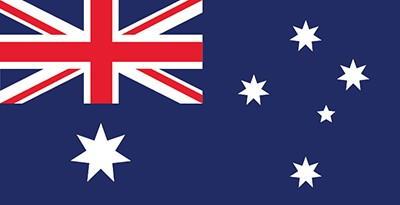
The Australian National Flag has three main elements on a blue background:
-
Union Jack (top left corner) – represents Australia’s historical links with Great Britain
-
Commonwealth Star (large seven-pointed star under the Union Jack) – six points for the six states, one point for the territories
-
Southern Cross (five white stars on the right side) – represents Australia’s location in the southern hemisphere
The flag is flown on government buildings, schools, and at public events. The test may ask you to identify or describe parts of the flag.
The Australian Coat of Arms
The Australian Coat of Arms is the official symbol of the Commonwealth of Australia. It appears on official documents, government buildings, and Australian passports.
Main features include:
-
A shield showing symbols of the six states
-
A kangaroo on one side and an emu on the other
-
A seven-pointed star above the shield
-
Golden wattle in the background
-
The word “Australia” below
The kangaroo and emu are native Australian animals. They are often said not to walk backwards easily, symbolising progress and moving forward.
For the test: You may be asked which animals appear on the Coat of Arms.
National Anthem: “Advance Australia Fair”
The national anthem of Australia is called “Advance Australia Fair.” It is sung at official events, school assemblies, citizenship ceremonies, and sporting events.
You do not need to memorise all the verses for the test. You should recognise the name and understand that it represents national pride and unity.
The anthem replaced “God Save the Queen” (now “God Save the King”) as the national anthem in the 1980s.
National Colours: Green and Gold
Australia’s national colours are green and gold. These colours are used by Australian sporting teams at international events like the Olympics.
The colours come from the golden wattle, Australia’s national floral emblem, which has green leaves and golden flowers.
For the test: You may be asked to choose the correct national colours from a list.
Other Important National Emblems (Including Indigenous Flags)
Golden wattle is the national floral emblem. It appears in official contexts and represents unity.
The Australian Aboriginal Flag:
-
Black top half – Aboriginal people
-
Red bottom half – the earth and spiritual connection to land
-
Yellow circle – the sun, giver of life
The Torres Strait Islander Flag:
-
Green, blue, black, and white design
-
White Dhari (traditional headdress) in the centre
-
Five-pointed star representing the island groups and navigation
Both flags are recognised official flags of Australia. They express respect for Aboriginal and Torres Strait Islander peoples.
Important Public Holidays
The citizenship test may ask about the dates and meanings of key public holidays that reflect Australia’s history and values.
Australia Day – 26 January
Australia Day is held on 26 January each year. This date marks the arrival of the First Fleet at Sydney Cove in 1788 and the beginning of British settlement.
On Australia Day:
-
Communities hold celebrations and events
-
Many new citizens receive their Australian citizenship at ceremonies
-
Australians reflect on the nation’s history and achievements
For many Aboriginal and Torres Strait Islander peoples, 26 January is a day of mourning or reflection. Many Australians acknowledge this and support efforts towards reconciliation.
For the test: You should remember that 26 January is Australia Day, the national day of Australia.
ANZAC Day – 25 April
ANZAC Day is commemorated on 25 April every year. It originally marked the landing of the ANZACs at Gallipoli in 1915.
Today, ANZAC Day honours all Australians and New Zealanders who served and died in wars, conflicts, and peacekeeping operations.
Typical commemorations include:
-
Dawn services at war memorials
-
Marches of former and current service members
-
Laying wreaths
-
The Ode of Remembrance
-
A minute’s silence
The values remembered on ANZAC Day are courage, sacrifice, mateship, and service.
For the test: You may be asked what ANZAC stands for, when ANZAC Day is held, or what happens on this day.
Other National Public Holidays to Recognise
The booklet also mentions other public holidays:
-
New Year’s Day – 1 January
-
Christmas Day – 25 December
-
Boxing Day – 26 December
States and territories also have their own holidays (such as Labour Day or Foundation Day), but the test mainly focuses on nationally significant dates like Australia Day and ANZAC Day.
Australian Geography: States, Territories, and Capitals
The citizenship test expects you to know the six states, two mainland territories, and their capital cities. You should also know that Canberra is the national capital.
States, Territories and Capital Cities Table
| State or Territory | Capital City | Simple Note |
|---|---|---|
| New South Wales | Sydney | Largest city in Australia |
| Victoria | Melbourne | Second largest city |
| Queensland | Brisbane | Gateway to the Great Barrier Reef |
| South Australia | Adelaide | Known for wine regions |
| Western Australia | Perth | Most isolated major city |
| Tasmania | Hobart | Island state to the south |
| Australian Capital Territory | Canberra | National capital of Australia |
| Northern Territory | Darwin | Located in the “Top End” |
Canberra – The National Capital
Canberra is the capital city of Australia. It is located in the Australian Capital Territory (ACT).
The site for Canberra was chosen as a compromise between Sydney and Melbourne in the early 20th century. It was purpose-built to be the national capital.
Key national institutions in Canberra include:
-
Parliament House (where the Australian Parliament meets)
-
The High Court of Australia
-
National museums and galleries
For the test: You may be asked which city is the national capital or which territory Canberra is in.
Australia’s Landscape and Location – What You Need to Know for the Test
Australia is a large island continent in the southern hemisphere. It is surrounded by the Indian Ocean and the Pacific Ocean.
Australia is the smallest continent but one of the largest countries by land area. The “Our Common Bond” booklet describes Australia as having many environments:
-
Beaches and coastlines
-
Deserts in the interior
-
Tropical rainforests in the north
-
Mountains and fertile farmland
Most of the population lives in coastal cities, especially in the south-east and east.
For the test: Basic questions may ask about Australia being in the southern hemisphere or being both a continent and a country.
Migration History and Multicultural Australia
The story of migration is central to understanding modern Australia. The citizenship test may ask about the general history of migration and what multiculturalism means.
From British Colony to Independent Nation with its Own Identity
The early non-Indigenous population was mainly British and Irish settlers, including convicts and free migrants.
Over time, especially after Federation in 1901, Australia began to develop its own national identity. While Australia kept close ties with Great Britain, it gradually became more independent.
Post-1945 Migration and the Growth of Diversity
After the Second World War, Australia invited millions of migrants and refugees. First, they came from the United Kingdom and Europe. Later, people arrived from Asia, the Middle East, Africa, and the Americas.
Migration changed Australian life in many ways:
-
New foods, music, and cultural traditions
-
Different languages spoken in communities
-
Growth of businesses and industries
Migrants and their descendants helped build roads, railways, farms, factories, universities, and hospitals.
Multiculturalism and Shared Australian Values
A multicultural society contains people from many backgrounds. In Australia, everyone is expected to:
-
Obey Australian law
-
Respect the rights and freedom of others
-
Share common civic values such as equality and “a fair go”
Australian Government materials stress that people are free to practise their culture and religion, as long as they follow Australian law.
For the test: You should understand that diversity is seen as a strength and that discrimination is not accepted in Australian society.
Study Strategy for History, Symbols and Geography
Knowing the facts is important, but you also need effective ways to remember and review them. Preparation for the australia and its people citizenship test involves studying the official booklet "Australian Citizenship: Our Common Bond" and using online practice tests, which can assist candidates in their preparation. Using a citizenship practice test or an australian citizenship practice test can help build confidence and improve recall for the actual exam. This section offers practical tips for intermediate English learners preparing for the citizenship test.
How to Use the “Our Common Bond” Booklet Effectively
Download the latest version of “Australian Citizenship: Our Common Bond” from the Department of Home Affairs website. Focus on Part 1 for the “Australia and its people” topic.
Study tips:
-
Read 2–3 pages every day
-
Underline or highlight key dates, names, and symbols
-
Take notes in simple English or in both English and your first language
Focus your notes on:
-
Key dates (1788, 1901, 25 April, 26 January)
-
Names of states, territories, and capitals
-
Names of national symbols and what they mean
Memory Tips for Dates, Places and Symbols
Group related facts together. For example, put all war dates and ANZAC information on one card or page.
Use flashcards:
-
One side: “1901 – what happened?”
-
Other side: “Federation of Australia, Commonwealth formed”
Or:
-
One side: “Flag – big star under Union Jack?”
-
Other side: “Commonwealth Star – federation and states/territories”
Draw a simple map of Australia and label each state and territory with its capital. This helps visual learners remember geography.
Practise saying dates and names aloud in English. This improves your pronunciation and helps you remember at the same time.
Practising with Citizenship Test Questions
Practice questions based on official content help you become familiar with the style and language of the real test. Practice tests are available and can help you become familiar with the test format.
Tips for practising:
-
Take short practice quizzes after reading each topic (history, symbols, geography)
-
Review questions you got wrong by going back to the relevant page of “Our Common Bond”
-
Use the official practice test on the Department of Home Affairs website
Ready to test your knowledge? Try our free Australia and its people practice quiz to see how well you know this topic.
Simple Study Plan Before Test Day
Here is a sample 7-day study plan:
-
Day 1–2: Read the Indigenous peoples section, make notes, learn key terms
-
Day 3–4: Learn major dates and events (1788, 1901, ANZAC, post-war migration), practise with flashcards
-
Day 5: Study national symbols and public holidays, practise identifying them
-
Day 6: Learn states, territories, and capitals, draw a simple map from memory
-
Day 7: Take full practice quizzes and review weak areas
Short daily sessions (20–30 minutes) work better than one long study session.
Want a complete study plan? Download our full citizenship test study guide covering all testable topics.
Summary: What to Remember about “Australia and Its People”
-
Australian citizenship: Australian citizenship is a privilege that offers enormous rewards, including liberties and the ability to apply for an Australian passport.
-
Civic responsibilities: Australian citizens have responsibilities such as voting in elections and serving on a jury, and can participate in the democratic process.
-
Citizenship Ceremony: After passing the test, applicants are invited to an appointment for a Citizenship Ceremony to make the Australian Citizenship Pledge.
-
Test content: The test presents questions on Australian values, focusing on democracy, equality, freedom, and respect for the rule of law.
-
Democratic beliefs: Understanding Australia's democratic beliefs, rights, and liberties is essential, and the test includes questions about the people and Australia's democratic beliefs.
-
First Australians: Aboriginal and Torres Strait Islander peoples have lived in Australia for 65,000+ years with a deep connection to land and culture
-
Key dates: 1788 (British settlement), 1901 (Federation), 25 April (ANZAC Day), 26 January (Australia Day), post-war migration and multicultural Australia
-
National symbols: Australian flag, Coat of Arms, “Advance Australia Fair” anthem, green and gold colours, golden wattle, Aboriginal and Torres Strait Islander flags
-
Geography: Six states, two territories, capital cities, Canberra as national capital
-
Migration and multiculturalism: Post-1945 migration created diversity; shared values include respect, equality, and freedom
-
Study strategy: Read “Our Common Bond” Part 1 carefully, use tables and flashcards, practise with sample questions
Understanding this topic helps you how to pass the citizenship test and prepares you to join and contribute to Australia’s story as a new citizen.

Download Citizenship Guide
Start with the Australian Citizenship – Our Common Bond booklet. It covers Australia’s history, values, and government. Read it online, download it, or get a printed copy.
Download
Use Free Practice Tests Online
The official guide has few questions — that’s why most people use online tests. Get unlimited free practice tests to check your knowledge and prepare with real exam-style questions.
Free Practice
Perfect Your Score
Practice makes perfect! The more you study and test yourself, the more confident you’ll be on exam day. Master every topic easily with our Free Australian Citizenship Practice Tests.
Progress Track