Walking into an unfamiliar test centre can feel stressful, especially when the outcome affects your future as an Australian citizen. The good news is that the Australian citizenship test follows a clear, predictable format. Once you understand exactly what to expect, much of that test day anxiety fades away.
 Learn exactly how the Australian citizenship test is structured, including the 20-question format and time limits.
- Understand how scoring works, including the strict 5/5 Australian values requirement and common pass-fail scenarios.
- Prepare confidently for test day by knowing what to expect before, during, and after the exam.
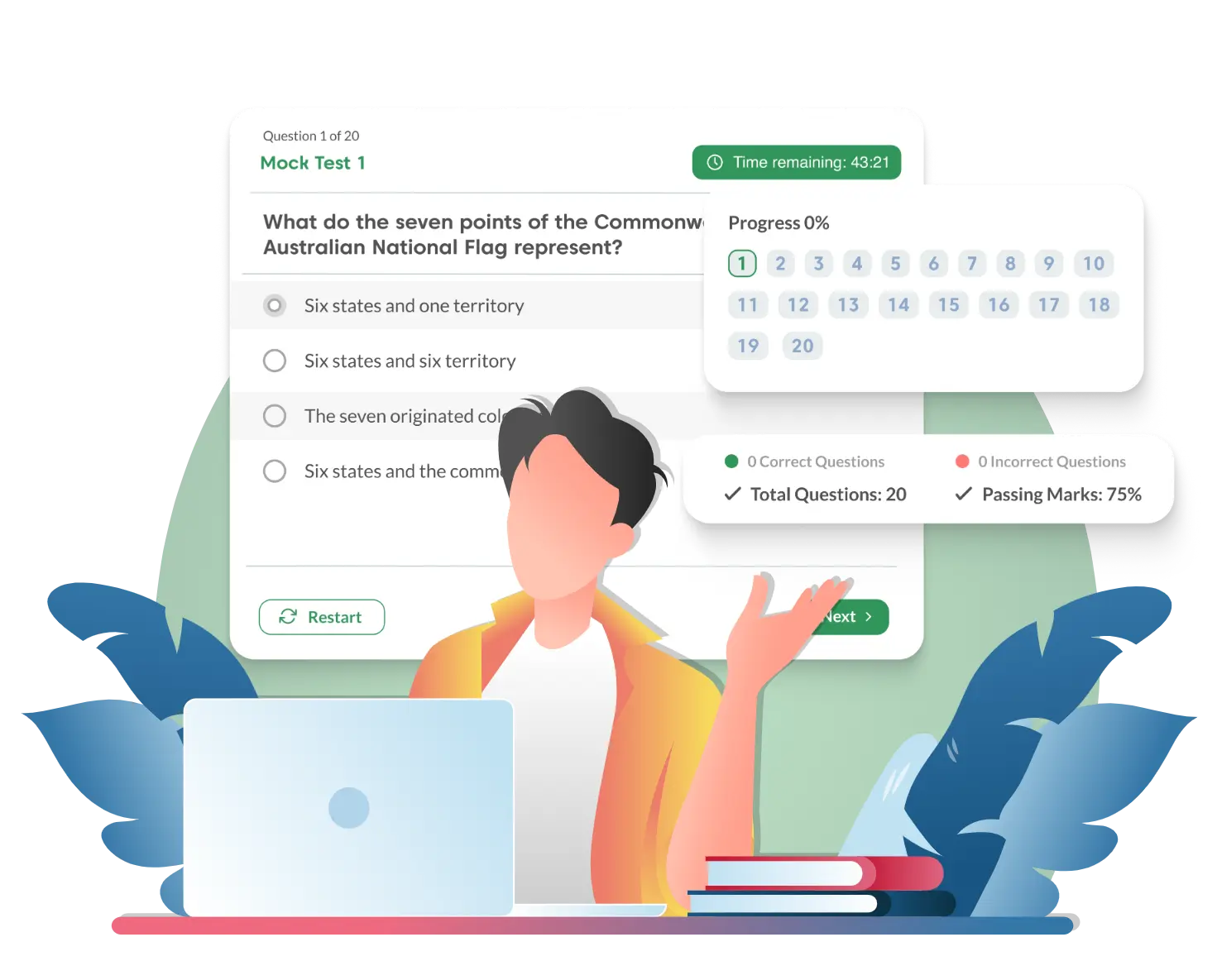
This guide explains everything you need to know about the test format, how the scoring system works, and what happens from the moment you arrive until you receive your result. Whether you are just starting to prepare for the citizenship test or you have your appointment letter in hand, this information will help you feel ready.
Test Format Overview
Let’s start with a quick summary of the Australian citizenship test format so you know exactly what you are walking into.
The test is computer based and delivered in English only. You will take it at an official Department of Home Affairs test centre. There are no paper versions, and no translators or interpreters are allowed.
The test consists of 20 multiple-choice questions. Each question shows you three answer options, and only one is correct. “Multiple-choice” simply means you select one answer from a list rather than writing your own response.
All 20 questions come from the official resource called “Australian Citizenship: Our Common Bond”. This booklet covers Australian history, government, law, and Australian values. If information is not in this booklet, it will not appear on the test.
You have 45 minutes to complete all 20 questions. Most people finish earlier than this, but the full time is available if you need it. There is no advantage to finishing quickly.
Five of the 20 questions focus specifically on Australian values. These values questions are especially important for scoring, which we will explain in the next section.
Australian Citizenship Test Format Summary
| Test Component | Details |
|---|---|
| Number of questions | 20 questions in total |
| Question type | Multiple choice, 3 options per question |
| Language | English only |
| Delivery | Computer based at a test centre |
| Time allowed | 45 minutes |
| Source material | Australian Citizenship Our Common Bond booklet |
| Values questions | 5 mandatory (must answer all correctly) |

Scoring System Explained
Many applicants are confused about how the Australian citizenship test is marked. This section explains the scoring rules in plain language so you understand exactly what you need to pass.
Home Affairs requires two things to pass the test. First, you must get at least 75% overall, which means 15 out of 20 questions correct. Second, you must answer all 5 Australian values questions correctly.
Both conditions must be met in the same attempt. Doing well in one part does not balance out the other. If you get 18 questions right overall but miss one values question, you will not pass.
These rules come from official Department of Home Affairs information and the common bond booklet. They apply to every standard citizenship test.
There are no penalties for wrong answers. This means there is no negative marking. If you are unsure about a question, it is always better to choose your best guess than to leave it blank. Unanswered questions count as incorrect.
The computer calculates your result immediately when you finish or when the 45 minutes ends. You will usually know whether you passed within moments of completing the test.
Pass Requirements
To pass the Australian citizenship test, you must meet both the overall score requirement and the Australian values requirement at the same time.
The overall requirement is straightforward maths. You need 15 correct answers out of 20 questions. That equals 75%.
The 5 Australian values questions are included within the 20 total questions. They are not extra questions added on top. All 5 of these must be answered correctly in the same attempt. Getting 4 out of 5 is not enough.
Here is why this matters: if a candidate gets 16 or 17 answers correct overall but only 4 of the 5 values questions correct, they still fail that attempt. The high overall score does not help.
There is no extra bonus or higher grade. The result is simply “pass” or “fail” based on these two rules.
For example, if you answer 17 questions correctly out of 20, and all 5 of those correct answers include the values questions, you pass. But if you answer 19 correctly and miss just one values question, you fail.
Pass/Fail Scenario Examples
The table below shows real-style scoring situations that often confuse applicants. Pay special attention to how the Australian values questions affect the outcome.
| Total Correct (out of 20) | Values Correct (out of 5) | Result | Reason |
|---|---|---|---|
| 20 | 5 | Pass | Meets both requirements with a perfect score |
| 18 | 4 | Fail | Missed one values question, which fails the mandatory 5/5 rule |
| 15 | 5 | Pass | Just meets both minimum requirements |
| 14 | 5 | Fail | Not enough total correct, even with all values right |
| 19 | 3 | Fail | Strong overall score but fails the values requirement |
| 16 | 5 | Pass | Exceeds the minimum total and has all values correct |
These scenarios show one consistent pattern. You must always have at least 15 correct answers overall and 5 out of 5 on the values questions. Missing either requirement means you do not pass, regardless of how well you did in the other area.
What Happens on Test Day
This section walks you through the full test-day journey so you can imagine each step and feel less nervous.
Exact procedures can differ slightly between locations, but the general steps are similar across Home Affairs test centres. You will check in, possibly have a short interview, sit the computer test, and receive your results.
Staff at the test centre are there to help with instructions about how to use the computer and start the test. However, they cannot help you with the answers to questions.
Some applicants have a short interview about identity and application details. This may happen before or after the test, depending on your appointment type.
Before, During, After
Before the test
Plan to arrive 10 to 15 minutes before your appointment time. This gives you time to check in at reception without feeling rushed.
When you arrive, you will show the identity documents listed in your appointment letter. This usually includes your passport or other photo ID that Home Affairs requested.
You will be asked to store personal belongings like phones and bags in a secure location. Follow the staff instructions carefully.
Some candidates have an identity and eligibility interview with a Home Affairs officer. The officer may ask basic questions about your citizenship application and confirm your understanding of Australian values and responsibilities and privileges of citizenship.
During the test
You will sit at an individual computer terminal. Staff will help you log in and show you how the system works.
The computer screen displays clear on-screen instructions before the test starts. Take your time to read these.
An on-screen timer shows how much of the 45 minutes remains. You can move forwards and backwards between questions, which means you can skip a difficult question and return to it later.
Read each question carefully, especially words like “NOT” or “EXCEPT”. These small words can completely change the meaning of a question.
You can change your answers before final submission. But once you click “Finish” or the time ends, your answers are locked.
After the test
Results usually appear on the computer screen shortly after you finish. Staff may also confirm the result and explain general next steps.
If you pass, your citizenship application continues to the next stage. This may include waiting for a citizenship ceremony invitation where you will complete the ceremony marks the significant milestone of becoming an Australian citizen.
If you do not pass, you will receive information about booking another test attempt. You can try again, and many people pass on their second or third attempt with more preparation.

Test Day Rules and Restrictions
This section lists common rules that apply at most Home Affairs test centres, based on official guidance. Following these rules helps you avoid problems on test day.
Personal items like mobile phones, smart watches, notes, books, and the “Our Common Bond” booklet are not allowed at the computer during the test. This is a closed-book assessment.
No translators, interpreters, electronic dictionaries, or other people can help during the test. You must complete it alone, using your own English language skills.
You must follow staff instructions about where to sit, when to start, and what to do if you need to leave the room briefly. If you need to use the bathroom, raise your hand and ask—the timer may continue running.
What to bring:
-
Identity documents listed in your appointment letter (such as passport, driver licence, or other photo ID)
-
Your appointment letter or email (printed or saved on your phone)
-
Any original documents Home Affairs has specifically asked you to bring
Eating is usually not allowed in the test room. Drinking water may be permitted depending on centre rules, so follow staff guidance.
Arriving late may mean the test cannot go ahead that day. Plan your travel time carefully and check the test centre address the day before.
Question Types and Styles
Understanding the different question styles helps you feel more confident when you see them on screen. All questions are based on the testable section of Australian Citizenship Our Common Bond.
Every question is multiple-choice with 3 options, but the way questions are written can differ. There are three main styles: factual questions, scenario questions, and questions using words like “NOT” or “EXCEPT”.
Factual questions
These ask for a specific fact from the booklet. For example, a question might ask about national symbols, important dates like Anzac Day, or the structure of the Australian Parliament.
These questions often start with words like “What”, “When”, “Who”, or “How many”. To answer them correctly, you need basic knowledge of key facts from the booklet.
The best way to prepare is to learn the key topics thoroughly. Pay attention to dates, numbers, and names related to Australian history, Australian society, and government.
Scenario questions
These are often used for Australian values topics. They give a short story about a situation—perhaps someone at work, in the community, or during an election—and ask what the person should do.
The correct answer is always the one that matches Australian values such as freedom, equality, mutual respect, and the rule of law. Even if another answer seems reasonable from your personal experience, choose the option that aligns with the values described in the booklet.
For example, a scenario might describe neighbours from different backgrounds and ask how they should treat each other. The answer will reflect commitment to Australian values like respect and equality.
“NOT” and “EXCEPT” questions
Some questions focus on what is not true. These can be tricky if you read too quickly.
When you see words like “NOT”, “NEVER”, or “EXCEPT” in capital letters, slow down. Read the question twice. If you are allowed scrap paper, consider underlining these words.
For instance, a question might ask: “Which of the following is NOT a responsibility of Australian citizens?” You need to find the one incorrect option, not the correct ones.
Questions cover all areas of the booklet including:
-
Australia and its people
-
Democratic beliefs
-
Rights and responsibilities
-
Government and law
-
Modern Australia and European settlement
-
Australian values
Repeated practice with official-style practice questions based on the booklet helps you recognise these patterns before test day.

Common Test Day Mistakes
Many candidates know the content but lose marks because of test-day mistakes. This list helps you avoid those errors so your preparation pays off.
Arriving late or without correct documents
If you arrive after your appointment time or forget your identity documents, the test may not proceed that day. Double-check your appointment letter the night before. Know exactly where you need to go and what to bring.
Not reading questions carefully
Missing small words like “NOT”, “NEVER”, or “EXCEPT” is one of the most common mistakes. These words completely change what the question is asking. Read each question slowly at least twice before selecting your answer.
Rushing through the test
Some candidates finish in 10 or 15 minutes and click “Finish” immediately. Remember, you have the full 45 minutes. Use any extra time to review your answers, especially the Australian values questions.
Spending too long on one question
Getting stuck on a difficult question can eat up valuable time. If you are unsure, choose the best answer, move on, and return later if time allows. Every question is worth the same, so do not let one question stop you from completing the rest.
Ignoring Australian values during study
Some applicants focus only on Australian history or government facts and treat the values section as “common sense”. This is risky. All 5 values questions must be correct to pass. Study the values chapter carefully and practise scenario-style questions.
Using unofficial or outdated sources
Websites and apps may contain incorrect or old information. Always use the latest “Australian Citizenship: Our Common Bond” booklet from the Home Affairs website as your main official resource. The test only includes information from this booklet.
These mistakes are easy to avoid with planning, consistent study, and calm reading on test day. Thousands of people pass the citizenship test every year by following a clear preparation approach.
Test Day Preparation Checklist
This practical checklist helps you feel ready and calm. Review it the day before your test.
One week before the test:
-
[ ] Complete reading the “Our Common Bond” booklet at least once
-
[ ] Review the Australian values section carefully—you need 5/5 on these questions
-
[ ] Take at least one full timed citizenship practice test (20 questions in 45 minutes)
-
[ ] Identify areas where you need more study and review those sections
-
[ ] Build confidence by doing practice questions until the format feels familiar
The day before the test:
-
[ ] Check the test centre address and plan your travel route
-
[ ] Gather all required identity documents and your appointment letter
-
[ ] Lay out what you will wear—comfortable, simple clothing
-
[ ] Get to sleep early so you arrive rested
The morning of the test:
-
[ ] Eat a light meal to stay focused
-
[ ] Avoid alcohol or anything that affects concentration
-
[ ] Leave with plenty of time to arrive 10–15 minutes early
-
[ ] Bring only what you need—leave study materials at home
During the test:
-
[ ] Read every question slowly and completely
-
[ ] Pay special attention to words like “NOT” and “EXCEPT”
-
[ ] Watch the on-screen timer and manage your pace
-
[ ] Answer all questions—guessing is better than leaving blanks
-
[ ] Review your answers if time remains, especially the values questions
After the test:
Whether you pass or need another attempt, you can keep using the “Our Common Bond” booklet and official-style mock tests to maintain and improve your knowledge. Success on the citizenship test is achievable with the right approach.
Understanding the Australian citizenship test format is a crucial step in your journey toward becoming an Australian citizen. You now know exactly how many questions to expect, how the scoring works, and what will happen on test day. This understanding helps you walk in with confidence instead of uncertainty.
Ready to put your knowledge into action? Try a realistic mock test based on “Our Common Bond” to experience the 20-question, 45-minute format before your real appointment. You can also read a detailed preparation guide that covers how to study the booklet effectively and practise under timed conditions. With consistent study and calm focus on test day, you can pass the test and take the next step toward your citizenship ceremony.

Download Citizenship Guide
Start with the Australian Citizenship – Our Common Bond booklet. It covers Australia’s history, values, and government. Read it online, download it, or get a printed copy.
Download
Use Free Practice Tests Online
The official guide has few questions — that’s why most people use online tests. Get unlimited free practice tests to check your knowledge and prepare with real exam-style questions.
Free Practice
Perfect Your Score
Practice makes perfect! The more you study and test yourself, the more confident you’ll be on exam day. Master every topic easily with our Free Australian Citizenship Practice Tests.
Progress Track